
The Emergence of AI Denialism
Why Critics Underestimate Compounding AI Advances
“AI denialism is our way of reducing the discomfort that arises when we realize machines are outperforming us in what we thought made us unique: thinking, creating, and understanding.”
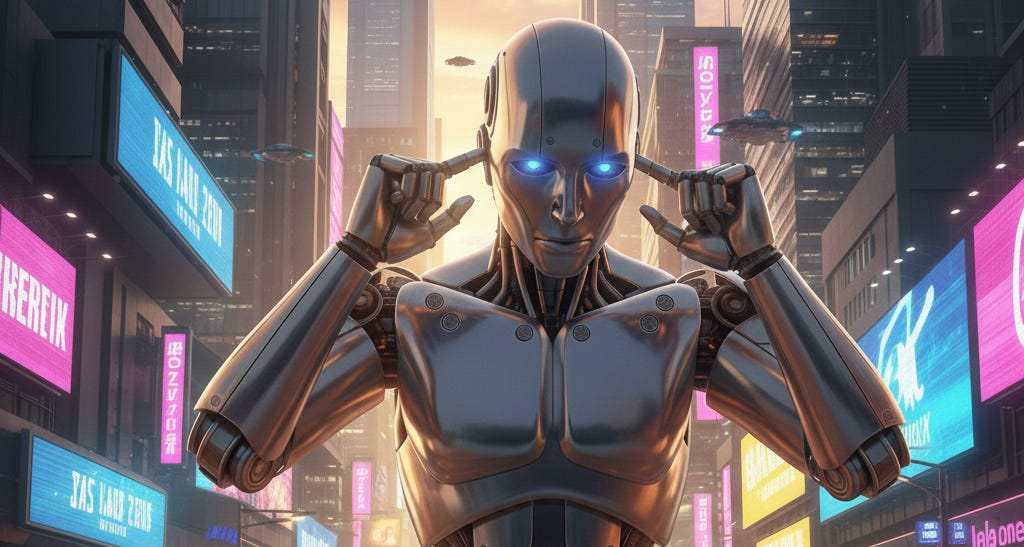
In recent months, skepticism about the AI boom has surged. Social media influencers and journalists claim that rapid advancements are stalling, scaling laws have hit a wall, and the entire phenomenon is another tech bubble ready to burst. They dismiss AI-generated images, videos, documents, and code as mere “slop.”
This view is misguided
In investing, alpha arises when you hold a view that diverges from consensus and turns out to be right. Today, AI investments might represent that very truth.
By every objective metric, AI capabilities are advancing at an unprecedented pace. The latest models, such as those seen in Gemini 3, demonstrate continued exponential progress. No technology in our lifetime, starting from programming on a TRS-80 in 1982, has evolved this quickly. Today’s systems are orders of magnitude more powerful than early computers, yet AI’s trajectory still leaves experts breathless.
We’re grappling with an unsettling truth, that humanity may soon lose cognitive supremacy to artificial systems. As Ayn Rand wrote, humans survive through our minds; our brains are our only weapon. This self-image as the planet’s superintelligent species underpins our success. But widely available AI models could soon outthink us across all domains, faster, more accurately, and even more creatively.
“Humans survive through our minds; our brains are our only weapon.”
Denialists often insist that machines will never match human creativity or emotional intelligence. Yet there’s no evidence to support this, and mounting signs suggest the opposite.
On creativity: Current models already produce new content at speeds and volumes no human can match. Arguments that AI lacks “inner motivation” are circular, they define creativity by human experience rather than output quality. Like humans, AI draws from vast influences and generates original work through pattern recognition and variation. The result? Superhuman-scale innovation that will disrupt jobs and industries.
On emotional intelligence: AI will soon read micro-expressions, vocal tones, posture, and even breathing patterns with superhuman precision. Personal assistants in our phones or glasses will model our behaviors and predict reactions. This creates an asymmetric vulnerability: AI can manipulate us expertly, while we struggle to detect deception behind photorealistic facades. Our reflexive trust in human-like faces, evolved over millions of years, becomes a liability in a world filled with generative agents.
Massive investments reflect AI’s impending permeation into every aspect of life: work, education, socialization, governance, science, and defense. Intelligent agents will assist, teach, and influence us daily, reshaping society at breakneck speed.
Consider this: In 2020, AI experts predicted a 75% chance that models could write efficient code for simple algorithms by 2033. Today, systems like Claude and Gemini dominate global programming competitions, outperforming top human teams. Yet the same outputs are derided as “slop.”
Humans iterate to refine work; we expect errors and fixes. AI follows the same process, but we hold it to unfair standards of instant perfection. This double standard hides the real power: rapid iteration at scale drives breakthroughs faster than ever.
Why AI Is Bigger Than We Think:
Exponential Scaling Drives Rapid Progress
AI capabilities advance exponentially through increased compute, data, and efficiency, with frontier models like Grok 4.1, Gemini 3, Claude Opus 4.5, and GPT-5.2 released in late 2025 showing massive leaps in reasoning and multimodality in mere weeks.Breakthroughs in Agentic and Reasoning Capabilities
New models excel at long-context planning, multi-step execution, coding, and professional tasks, enabling agentic workflows that operate independently and outperform humans in specialized domains.Deep Integration Across Industries
AI transforms healthcare with drug discovery acceleration, finance with advanced risk tools, education with personalization, and more, boosting productivity and revenue in exposed sectors far beyond initial hype.Human Underestimation of Compounding Growth
People predict linear change but miss exponential compounding; consistent doubling trends in compute and performance mean small 2025 gains lead to profound economic and scientific shifts over the next decade.
Explore our previous articles for deeper insights into our AI picks
Why the AI Bubble Critics Are Missing the Point.
Skeptics classify AI as the latest tech bubble. They may be right about short-term volatility. Speculation will create price swings, and valuations will overshoot fundamentals. But the long-term trajectory is clear. Like the steam engine, electricity, and digital computing before it, artificial intelligence will trigger a wave of creative destruction ac…
The AI Revolution: An Unstoppable Force Reshaping Our Future
The AI transformation is accelerating at an unprecedented pace, and it’s only the beginning. This seismic shift is not a passing trend. It’s a fundamental redefinition of how the world operates.


